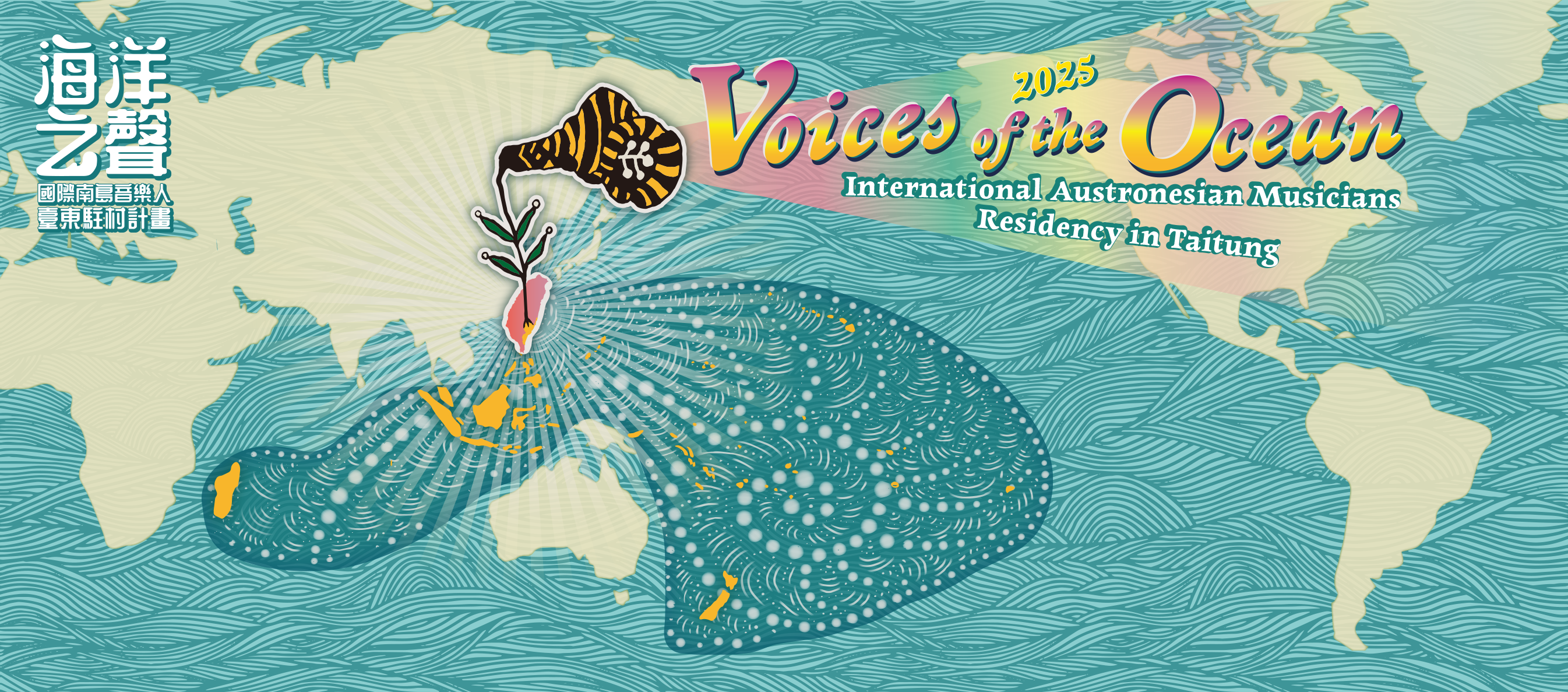
Voices of the Ocean: International Austronesian Musicians Residency in Taitung :::
Author|Shura Taylor (吳曉瑩 Bulan)
The Beginning: When the Austronesian Wind Blows Toward Taitung Once More
“Onward the Ocean, Connecting Through Music— The ocean serves not only as a natural boundary between Taiwan and other Austronesian countries, but also as a vessel of shared history, cultural memory, and a bridge that connects people through music. ” This passage appeared in a Facebook post by the Voices of the Ocean team on May 19, announcing the opening of registration the following day and symbolizing the official launch of the 2025 Voices of the Ocean: International Austronesian Musicians Residency Program in Taitung. In 2024, the Taitung County Government initiated the Voices of the Ocean Residency program for the first time. Through an international open call, musicians from Tahiti, Malaysia, and the Philippines were invited to Taitung to collaborate with local Indigenous artists. Over the course of a month, participants used music as a bridge to engage in cross-cultural co-creation, village immersion, workshops, and public performances. Their works—blending Indigenous languages, traditional instruments, and contemporary musical vocabularies—embodied both innovation and continuity. Through shared living and creative exchange, they deepened the collective memory and kinship among Austronesian peoples. This initiative opened a new chapter of interregional collaboration, leading to return performances, exchanges at international festivals, and ongoing joint projects. The mutual understanding that transcended linguistic and geographic boundaries became a foundation for the continued resonance of Austronesian culture. In 2025, the project entered its second year. Compared to the inaugural edition, this year’s design placed greater emphasis on the processes of co-living and co-creation. The curatorial team chose Just Arts House — Taitung Performing Arts Incubation Base, located in Taitung City, as the base for residency and creation, enabling musicians from Madagascar, Malaysia, Indonesia, and the Philippines to live under the same roof. Within everyday conversations, laughter, and spontaneous improvisations, creativity flowed freely—melodies took shape over meals and jam sessions. Once again, Taitung became a stage where Austronesian voices converged, a place where islands could listen to one another anew. Voices of the Ocean is more than a residency program—it is an experiment, using music as a medium for island voices to meet and resonate in Taitung. Through interregional collaboration and daily cohabitation, the organizers hope to bring artists into villages and schools, fostering shared learning and listening with local residents. In this process, Austronesia is reimagined not merely as a geographic term, but as a shared sensibility bound by the ocean. From mountain to sea, from village to city, the residency unfolds as a voyage woven by sound. When music becomes the language of dialogue and rhythm replaces the need for translation, Taitung transforms—not just into a host site, but into a harbor where the Austronesian world gathers once more.
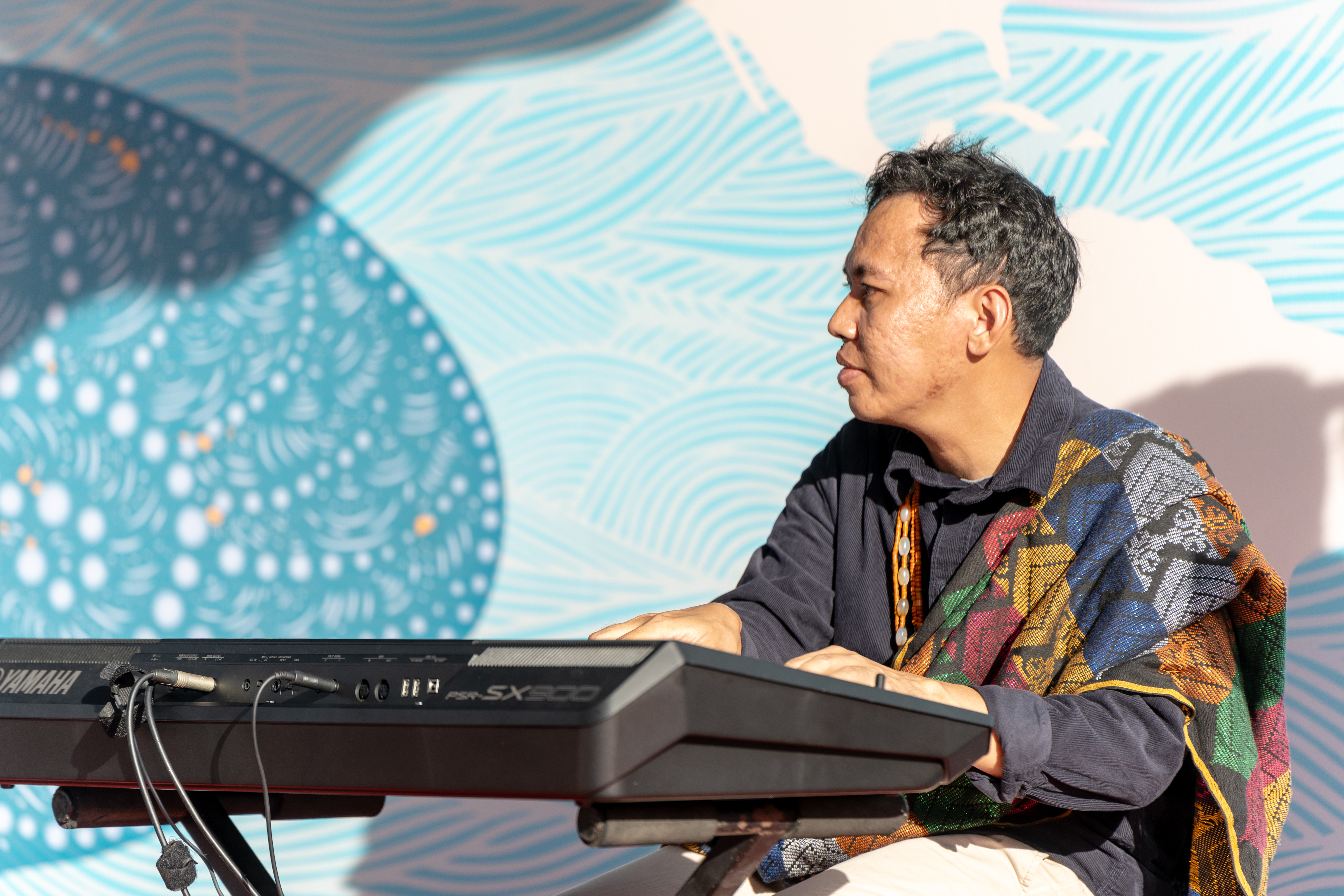
Indonesian musician Gardika Gigih is a pianist and composer.
、馬來西亞音樂人Arthur-Borman和Paliulius樂團共創。.jpg)
Malagasy musician Lala Andrianaivo (front, holding the instrument Valiha), Malaysian musician Arthur Borman, and the Paliulius Ensemble co-created and performed together.
Opening Night
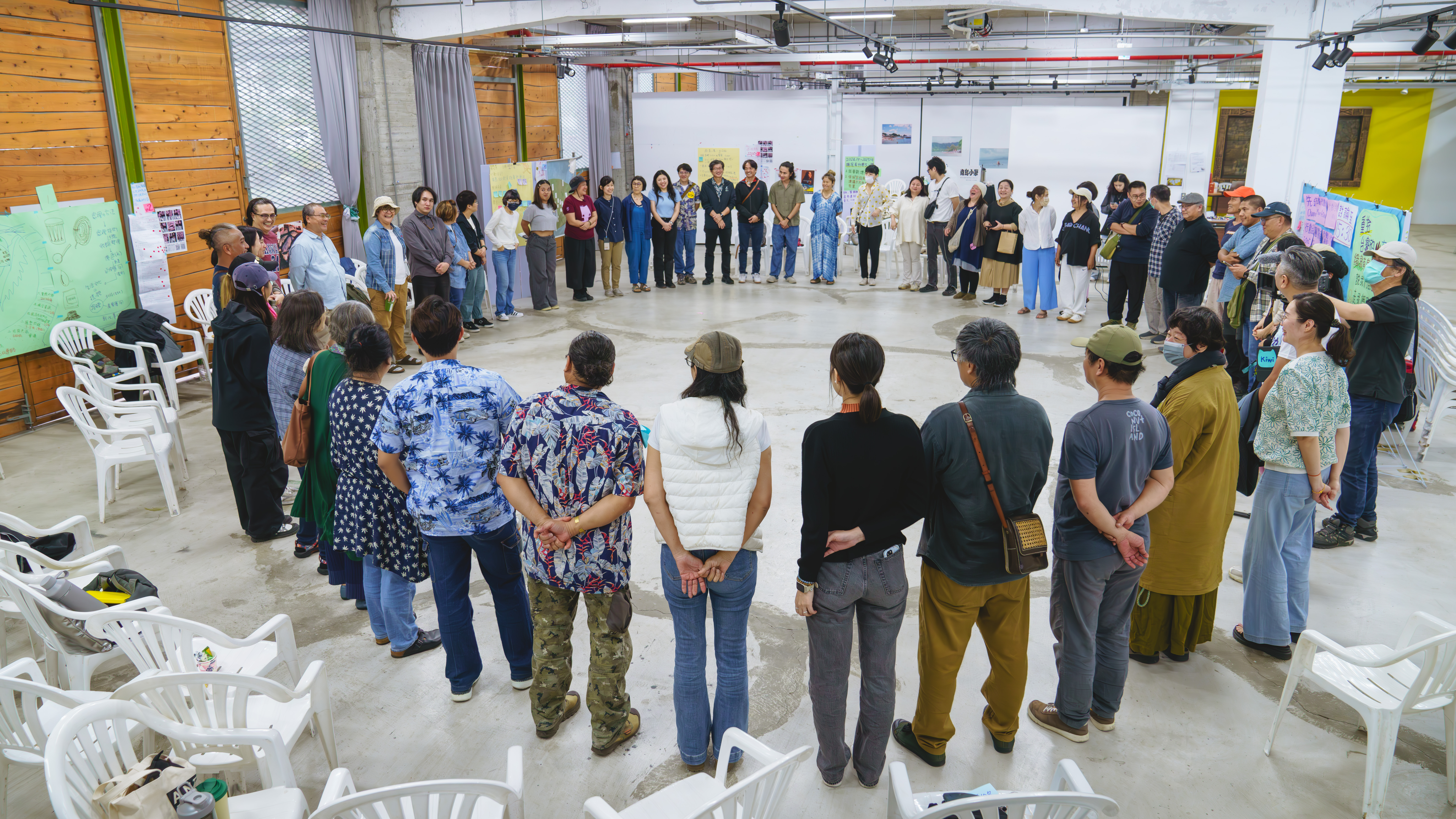
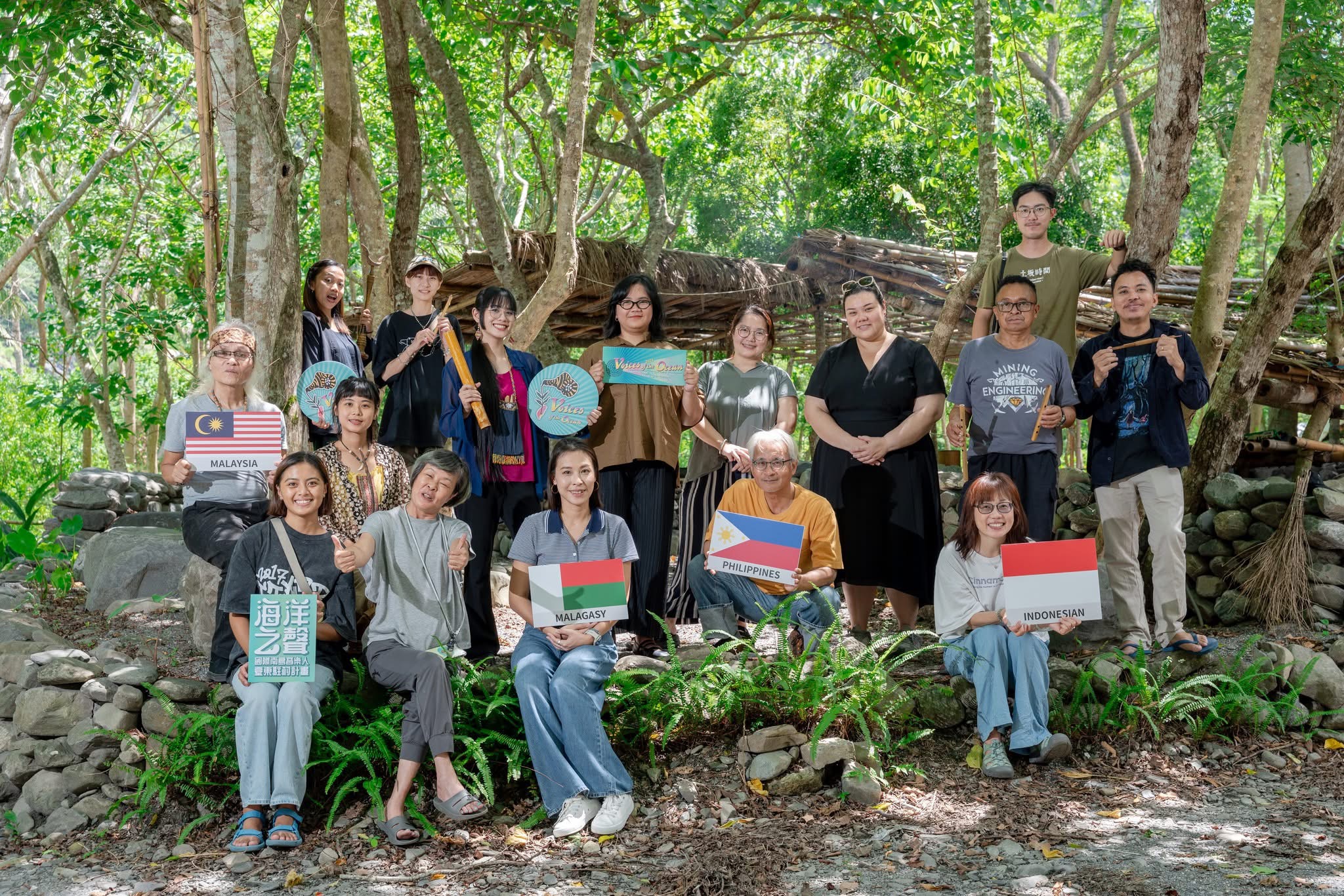
Voices of the Ocean officially commenced at Just Arts House on the afternoon of August 30. Alongside the resident musicians and local collaborators, attendees included Taitung County Cultural Affairs Director Nick Lee, curators Homi Ma and Dakanow of Good Collection Studio, and well-known Taitung musician Hilo Wang. The curators and guests took turns sharing the origins and vision of the project before inviting the musicians to introduce themselves to one another, setting a tone of openness and collaboration. Soon after, the three Austronesian music groups began their first co-creation sessions with local bands in different spaces of Just Arts House. As night fell, about sixty musicians and guests gathered, and melodies and rhythms began to weave together. This year’s artists in residence—Arthur Borman Anak Kanying (Malaysia), Lala Andrianaivo (Madagascar), Govinda Sanglay (Philippines), Gardika Gigih, Bunga Dessri Nur Ghaliyah and Dinar Rizkianti (Indonesia)—each brought their distinct musical traditions into dialogue with Taiwan’s Indigenous sounds. Arthur, from Annah Village near Kuching, Sarawak, played the pratuokng, a bamboo zither tuned to a pentatonic scale; Bunga and Dinar, independent Indonesian composers and musicians dedicated to cultural preservation, gender equality, and ecological creativity grounded in local knowledge systems, performed through flute and voice; Govinda performed on the saronay, a traditional bamboo instrument from northern Luzon, while Gardika blended synthesizer and harmonica to create textured harmonic landscapes that bridged acoustic and electronic sound worlds. After performances by local bands, Dakanaw and Hilo opened the evening, followed by Arthur, whose deep, resonant tones on the pratuokng filled the space. The Taitung-based band Paliulius followed with songs in the Rukai, Pinuyumayan, and Seediq languages, grounding the performance in Taiwan’s Indigenous soundscape. From the Philippines and Indonesia, Govinda and Gardika created a musical conversation between the saronay, piano, and harmonica, merging traditions through improvisation. Meanwhile, the Seredaw Band exchanged phrases between voice, jaw harp, and moon guitar, their sounds shimmering in quiet dialogue. The final performance brought together Balai with Indonesian musicians Bunga and Dinar, whose spontaneous improvisation carried the evening’s energy to its peak. Guided with gentle warmth by host Insay Kungkuwan and translated by Shura Taylor, the evening unfolded as a prelude to the month-long journey ahead—an opening where music and languages resonated across seas, setting the course for the voices of the ocean to continue their voyage together.
Dialogues Between Mountain and Sea
August 27–29|tjuwabar Indigenous Village
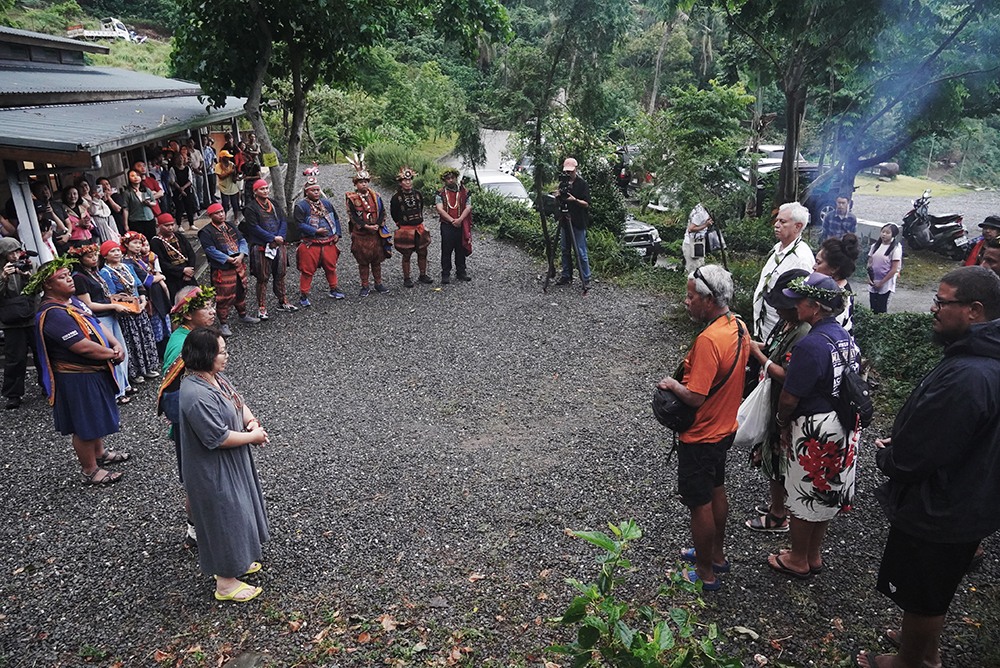
On August 27, the musicians set out on a southbound journey to tjuwabar, a Paiwan community nestled at the foot of Daren Township. The village, framed by mountains and guided by rivers, greeted them with air rich in the scent of wood and soil. Local youth Ljeljeng and Giyu led the group along the winding village paths. When they reached a nearby stream, Giyu pointed to the flowing water and said, “If you ever lose your way, just follow the river, and you will find your way home.” It was wisdom deeply rooted in the land, one that seemed to mirror the musicians’ purpose: to begin from nature and follow the path of sound. As they walked through the village lanes, the young guides shared stories of community life—from the ancestral house of the Patjalijinuk family to the churches in the village and cultural hubs. They spoke of the Sapari Cultural and Art Studio, a woodcarving workshop founded by a late artist and now continued by returning youth. Within the carvings, the imagery of “home” and “protection” intertwined: on this land where faiths converge, the serpent appears both as a church robe motif and as a guardian spirit in Paiwan cosmology. The afternoon exchange took place in the Talem Tree House, where the residential musicians shared melodies from their homelands, and village youth responded with traditional songs. Giyu played the nose flute, his long breath weaving into the visitors’ rhythms. Arthur presented his pratuokng—an instrument he had crafted by hand over 168 hours and kept by his side for thirteen years, its bamboo harvested under a winter full moon for strength and durability. Bunga brought several bamboo flutes and the striking tarompet penca, a traditional Indonesian wind instrument with a bright, ornate tone often used to accompany dance. Dinar, using only her voice, demonstrated her range from soft murmurs to powerful throat tones, revealing the layered energy of the human voice. On August 29, the final morning in the village, the musicians visited the Tjuwabar Community Care Station, where elders of the community had gathered. The musicians performed for the elderly audience, whose faces lit up with delight; some even stood up and began to dance. In turn, the elders sang a traditional Paiwan song, which the visiting musicians eagerly learned. Before departing, the group visited Tjuwabar Golden Tree—a community information hub and guesthouse run by returning villagers, affectionately known as “the village’s living room.” There, they viewed Giyu’s graduation exhibition, a multimedia dialogue with the land expressed through painting and video. On the canvases, flowing colors mingled with the sounds of forests and the shimmer of river light, forming fragments of memory suspended between image and sound. The musicians watched quietly, then exchanged embraces and songs in farewell—turning the moment of parting into an echo gently gathered by music.
September 4–5|‘atolan Indigenous Village
On September 4, the musicians traveled north along the coast to ‘atolan, where winds from the Pacific drift inland. The old sugar factory chimney stood quietly as witness—both to the colonial past and to the community’s rebirth through art. At the factory, they visited sculptor Siki Sufin’s woodcarving studio and listened as the curator recounted stories of elders who had been sent to war by colonial powers—first fighting for Japan during WWII, and later for the KMT after 1945. At dusk, they gathered at 9dolan, a village-run soap studio, for an evening of food and music exchange. The Rock ina women group of ‘atolan prepared dishes from mountain and sea. After dinner, the musicians and the women exchanged songs; melodies lingered into the night. Later, the musicians walked together to the beach, guided by the Fo’is no ‘atolan Stargazing group. The next day, the program continued at the Herflow Life Co-Living Studio, co-hosted by ‘atolan artists and the Austronesian musicians. During the “Austronesian Aesthetics: An ‘atolan Conversation” discussion, participants sat in a circle, beginning with a simple question: “Where are you from?” Potter Da’ai shared how he uses local clay in his creations, saying, “We cannot merely copy our ancestors; we must absorb their nourishment and let the world hear our own language.” Having returned to the village after forty years, he now uses his art to reconnect with the land and converse with the world. As night fell, music filled the space once more. Austronesian musicians and ‘atolan youth performed in turn. During the community segment, singer Suming presented his song “Watermelon.” Quoting the elders, he smiled: “A person can finish an apple alone, but not a watermelon.” The song, he explained, is about sharing. The night concluded with a series of duets among the visiting artists, each exchange revealing new layers of dialogue between instruments and voices. The evening culminated in a grand finale, as all six resident musicians joined a local drummer in a spontaneous ensemble—an improvised convergence of rhythm and energy that brought this two-day visit to the village to a close.
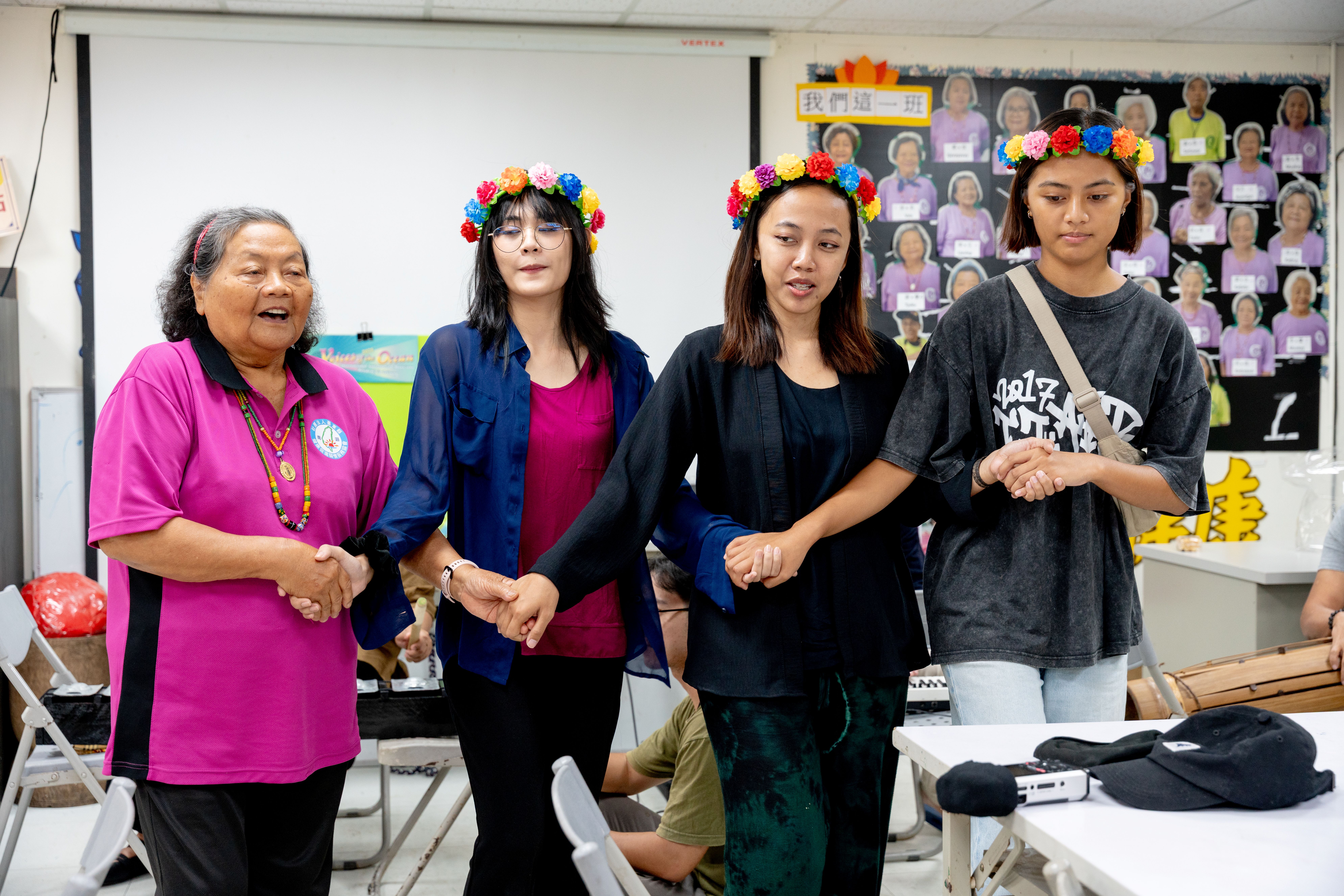
Indonesian musician Bunga Dessri and Filipino musician Govinda Sanglay danced together with elders from Tuban Community and youth from the Community Development Association.
與其他國際音樂人在都蘭部落自在的jam起來。.jpg)
Indonesian musician Dinar Rizianti (wearing the striped shirt) jammed freely with other international musicians in the Dulan community.
September 8–9|Amis Folk Center (Duli) & Moonlight Sea Concert
The residency’s final coastal stop took place on September 8 and 9 at the Amis Folk Center in Duli, where a two-day series of workshops was deliberately scheduled to coincide with the Moonlit Sea Concert. This arrangement allowed musicians and participants to gather in the early afternoon for hands-on learning and remain through the evening for a shared performance. The workshops introduced instruments and performance practices from across the Austronesian world, deepening local understanding of the cultural diversity connected by the sea. On the first day, Govinda Sanglay from the Philippines led a workshop on making the tongatong, a bamboo percussion instrument from northern Luzon. Participants sat in a circle, striking their freshly crafted instruments lightly against the cement floor as Govinda taught rhythm through the children’s song “Oy Na Oy.” Next, Lala Andrianaivo from Madagascar led participants into a 12/8 dance rhythm using the valiha and kabosy. His workshop emphasized rhythm as bodily communication—movement as a shared language beyond words.
The following day, Arthur Borman Anak Kanying from Malaysia joined Indonesian musicians Dinar Rizkianti and Bunga Dessri Nur Ghaliyah, who guided participants through Sundanese vocal and bamboo traditions. Arthur’s pratuokng resonated with deep, steady tones as participants joined in ensemble, while Dinar’s fluid voice and Bunga’s bamboo flutes revealed the depth and diversity of Indonesian music. Together, they embodied the project’s vision of co-creation and attentive listening. On both evenings, as the sun descended beyond the Pacific horizon, the group made their way to the grassy field of the Duli Visitor Center for the Moonlit Sea Concert—a recurring celebration of music beside the ocean. The gentle sound of waves mingled with melodies carried by the night breeze, turning the coast into a living stage. On the second night, 2024 resident musicians Rahera and Taua, both from Tahiti, reunited with the Pinuyumayan Youth Choir, their collaborators from the previous year’s residency. Ten months later, their voices intertwined once more beneath the moonlit sky, rekindling the kinship of islands through song.
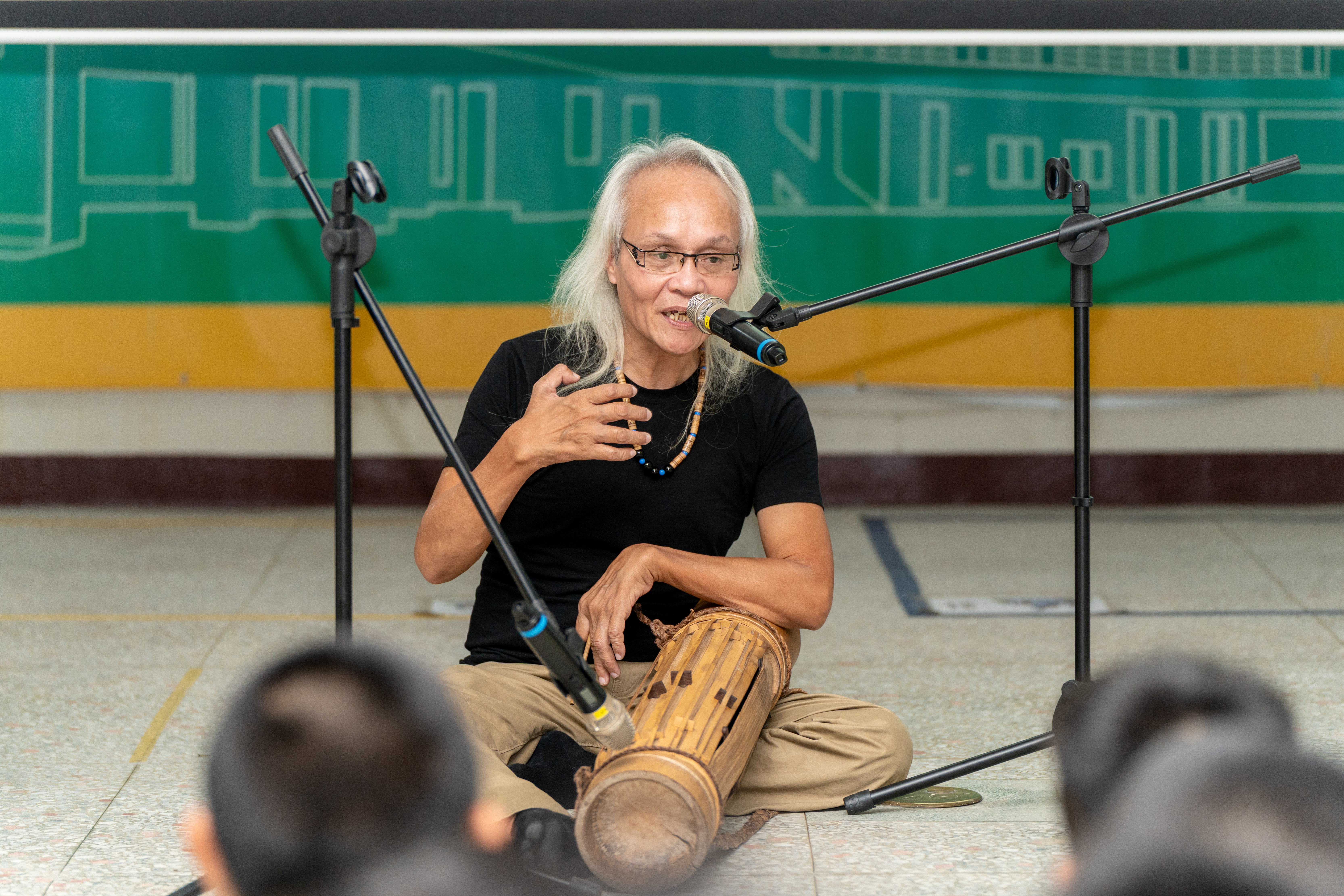
Malaysian musician Arthur Borman introduced the historically significant bamboo instrument Pratuokng from Sarawak to children at Wenquan Elementary School.
Entering the Classroom: Extending the Residency into Education
On September 16 and 17, the six resident musicians visited Hot Spring (Wen Quan) Elementary School in Beinan Township and National Taitung University’s Affiliated Sports High School, bringing the spirit of Voices of the Ocean into the classroom. At Hot Spring Elementary, Bunga and Dinar led playful workshops that helped children discover sound through imagination and movement. Using melodies and words from everyday life—like “car” and animal sounds—they created rhythmic games where students formed groups, sang, and moved in serpentine lines across the room. The classroom overflowed with laughter and rhythm, echoing the same vitality that had animated the residency. Arthur’s pratuokng and Govinda’s saronay especially captured the children’s curiosity and delight. At the Taitung Sports High School, Dinar guided students in creating layered harmonies through body percussion and vocal rhythm, calling it “the architecture of sound.” From Malaysia, Arthur introduced the traditional bamboo dance, beginning with simple rhythmic patterns and gradually expanding into a full-body movement challenge that tested the students’ coordination and sense of rhythm. As bamboo poles struck the floor and students leapt in time, the rhythm of the archipelago came alive within the schoolyard, allowing students to feel the heartbeat of distant islands through their own bodies. These two school exchanges extended Voices of the Ocean beyond the realm of artistic residency into education. Through sound, play, and dance, the musicians realized the project’s vision of the ocean as a force of connection, enabling children to encounter another island’s culture not through textbooks, but through the senses—to learn by listening, moving, and sharing in rhythm.
Echoes of Co-Creation: The Continuation of Sound
Throughout the month-long residency, weekends at Just Arts House became dedicated spaces for co-creation. During the first collaborative weekend, the resident musicians divided into three groups to explore new ideas that would later shape their final recordings. The Seredaw Band began by composing around the sound of the saronay, whose fixed tuning could not be altered. Drawing inspiration from shared Austronesian words such as lima (five, hand) and bulan (moon), they envisioned a piece that portrayed Taiwan as the “mother of Austronesia” and the surrounding islands as children returning home. This concept became the foundation of Mother’s Call. The Paliulius Orchestra built their composition from the sound of the wind, followed by Arthur’s single-note pratuokng motif. Arthur performed a solo that combined both playing and singing, echoed by Paliulius’s wis wis calls and joined by Lala’s bamboo flute and harmonica. The dialogue expanded as the guitar entered, layering Truku and Rukai chants over the ensemble’s shifting textures—an interplay of breath, rhythm, and voice. Meanwhile, the Balai & GaGa Band, working with Dinar and Bunga, began shaping their piece in three “chapters.” Chapter 1 opened with a sense of emptiness and gradually introduced sound elements to express trauma, anxiety, and the pain born of love. Chapter 2 turned toward healing and hope, while Chapter 3 invited the audience to participate, transforming grief into collective resonance. In the final week, the three collaborative groups entered the Denglu Music recording studio, where, together with sound engineer Kui Truzaljum, they transformed the fruits of their journey into lasting traces of sound. This period of co-creation culminated in two compositions from each group. Bunga and Dinar, together with the Balai & GaGa Band, created Mother Ocean and Agogo Party. Mother Ocean fuses Sundanese Ronggeng Gunung chanting with Taiwanese Indigenous voices and experimental textures. Agogo Party, inspired by the Ghost Festival, centers on Yawyaw, a newly coined word that transcends linguistic boundaries, combining Indonesian tabla, Balinese suling flute, guitar, and Indigenous chant in a joyful rhythm of celebration. Lala, Arthur, and the Paliulius Orchestra co-created Voices of the Ocean: Hymn and Voices of the Ocean: Land. Hymn intertwines Truku-language chants with valiha and bamboo instruments, paying homage to ancestors and the land. Land merges Malagasy and Malaysian rhythmic patterns with Taiwanese melodic phrasing, symbolizing shared island origins and resonance. Govinda, Gardika, and the Seredaw Band collaborated on Pa pu ent ni I na (Mother’s Call) and Ki se nai ni tja ga laus (Blessing of the Ancestors). The first envisions Taiwan as the “Mother Island,” calling her children home across the sea; the second reinterprets a joyful Paiwan song, blending piano and moon lute melodies to offer prayers for peace and wisdom. On September 20, these collaborative works premiered at Xinsheng Square in Taitung City. Beneath the blazing afternoon sun, the audience’s enthusiasm never waned, some swayed to the rhythm, others followed the dance of shadows. When Agogo Party began, the crowd rose to their feet, laughter and applause rolling like waves against the stage. That evening, musicians and organizers gathered for a farewell dinner—the final Pakelang (end of work celebration) of the residency. Conversation and laughter flowed, carrying the melodies of the day into the night. The journey of sound had come full circle, yet the island winds seemed still to be blowing, carrying music onward across the sea.
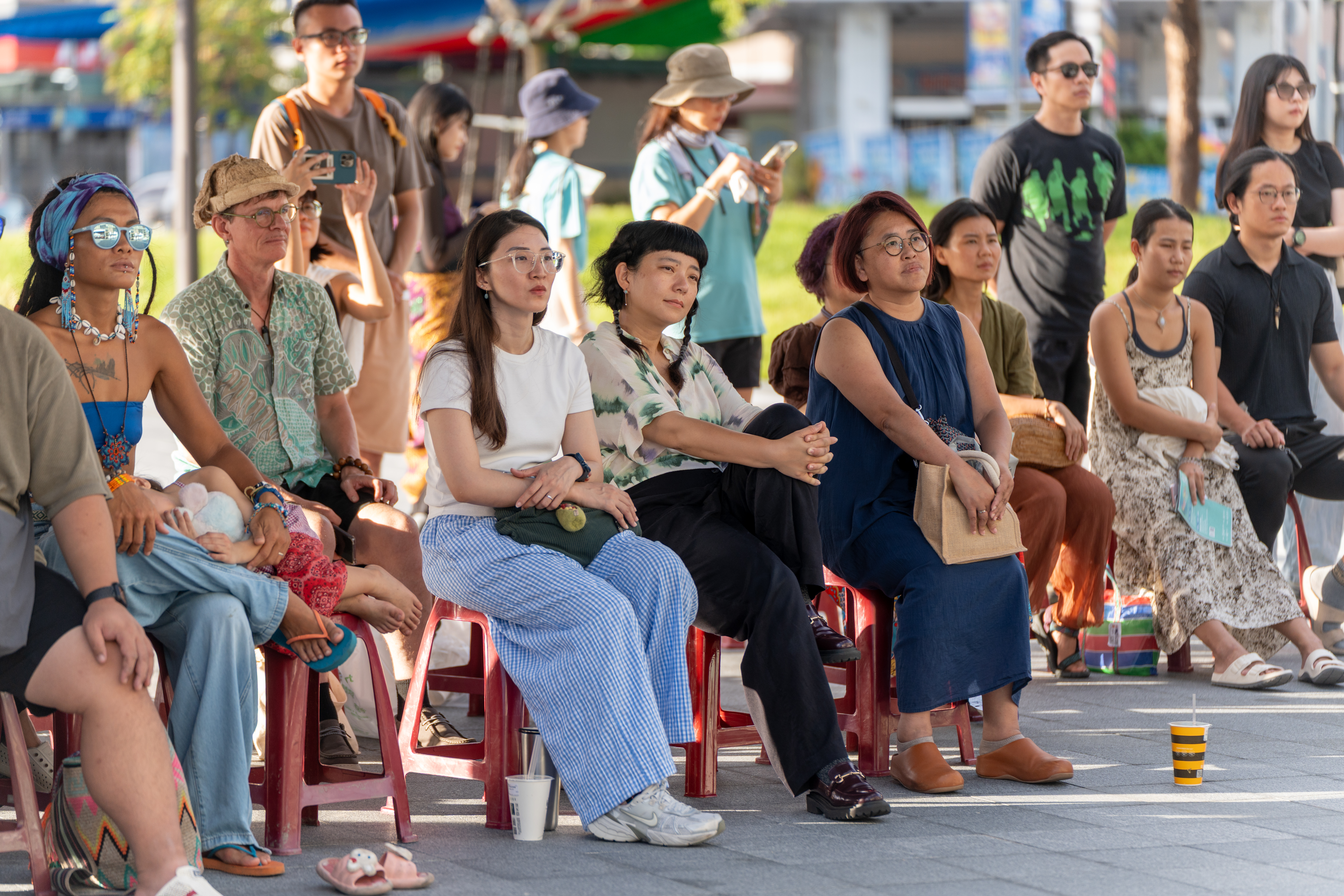
On September 20, the audience enjoying the musicians’ gathering at Xinsheng Plaza was also quite diverse.

The 2025 Voice of the Ocean concluded successfully after the concert, with all the musicians taking an emotional group photo.
Conclusion
From the beginning, Voices of the Ocean set out to explore how the ocean, long seen as a boundary, could once again become a bridge—a living conduit connecting islands through sound. Across the month-long residency, that vision took form as music became the language of recognition, and Taitung emerged as a harbor where these voices could meet, listen, and create together. The project was initiated by the Taitung County Government, carried out by Good Collection Studio, out of a shared belief that cultural exchange begins with listening. For a region where the mountains meet the sea, and where Indigenous traditions continue to shape contemporary life, the residency was conceived as a platform to renew Austronesian connections through lived experience rather than representation. It invited artists not only to perform, but to dwell, to share everyday rhythms, and to discover how sound can regenerate kinship across islands. Their languages, voices, and rhythms each followed different paths, some rooted in ancestral chants and others born of contemporary experimentation, yet all converged in dialogue. Within the Voices of the Ocean: International Austronesian Musicians Residency in Taitung, six artists sailed between Taitung City, ‘atolan, and Tjuwabar, drawing inspiration from the land and letting sound flow freely between mountain and sea. It was more than a meeting across borders; it was a journey woven by sound. As their melodies intertwined with the sea breeze of Taitung, the island itself answered with its own echo, an echo of memory, and a song still unfinished. The ocean that once carried the ancestors’ canoes now carries their songs, binding islands through rhythm and breath. From the wind that moves through the mountains to the tide that touches every shore, the music born in Taitung continues to drift outward, finding new listeners and new lands. In that ongoing movement—of wind, tide, and sound—the Voices of the Ocean remain alive. What began as a gathering of musicians has become a continuing current of connection, reminding us that the sea does not divide us; it listens, carries, and returns our voices, uniting the islands once more through song. Photos | Taitung County Government Author | Shura Taylor (吳曉瑩 Bulan) Shura Taylor is a music and language practitioner and ethnomusicology researcher born in Macau and raised in both Macau and San Francisco, United States. She is currently based long-term in the Nanwang Puyuma community in Taitung, Taiwan, where she focuses on ethnomusicology and cultural fieldwork while actively engaging in cultural exchange between the local community and the international sphere. Her work spans music education, academic research and conference presentations, as well as international translation and interpretation. Fluent in both Mandarin and English, she specializes in cross-cultural communication for formal settings, academic symposia, cultural events, and diplomatic receptions, and has long supported the international transmission and advocacy of Austronesian cultures, Indigenous language preservation, and local knowledge.
One-in-a-Thousandth Encounter: Memories of the 2024 Voices of the Ocean International Austronesian Residency Exchange in Taitung
Author | Lin Sung-En
One in a Thousand Encounter in Life
The Voices of the Ocean (VOC) project(海洋之聲:國際南島音樂人臺東駐村交流計畫)reached its final farewell. Outside the Taitung Train Station lobby, we reluctantly said goodbyes. As Tauapaohu strummed his ukulele and began singing passionately, Rahera followed his lead, dancing with rhythm and emotion. The scene brought back vivid memories of the past month, where we sang and created music together. What started as shared learning had become heartfelt songs of parting. Although I had promised myself not to cry, the tears broke through as the emotions became overwhelming. This way of expressing deep emotions through singing and movement was not a mere performance. It embodied the natural response of various communities to the universe's emotional tides, a profound interaction that resonated deeply with the essence of the VOC project. Unlike most international music exchanges that focus on short visits and multi-site performances, the VOC project, initiated by the Taitung County Department of Cultural Affairs(臺東縣政府文化處), emphasized a month-long residency. The program invited musicians from across the Pacific Rim, selecting three international groups to visit Taitung. These musicians were matched with local music teams, fostering collaboration in co-creation performances. The local teams were also tasked with organizing cultural and musical workshops and community visits to help the international artists gain a deeper understanding of Taitung. In November 2024, I had the privilege to collaborate with the Pinuyumayan Youth Choir(卑南族青春歌隊)and the Tahitian musicians Tauapaohu and Rahera. Additionally, I had the opportunity to meet Eric and Matyline from the Cordillera region in the Philippines, and Razif and Najmie from Sabah, Malaysia. Under the arrangements of Good Collection Studio(好的創藝工作室), the musicians were based at the Just Arts House(就藝會), operated by the Hunter School team(獵人學校). The two-day music exchange workshop and the final collaborative concert were held at the National Museum of Prehistory(國立臺灣史前文化博物館). These organizations, with their rich experience in facilitating Austronesian cultural exchanges and music performances, seamlessly supported the VOC project. At the same time, the Museum hosted tattooists from five countries participating in the Pasiwali Music Festival for the Tattooing Waves Festival. This resulted in overlapping events featuring tattooing, Austronesian music workshops, and performances. The VOC project became a cultural feast, connecting Taitung to the world and bringing the world to Taitung. During those two days, on the green lawns of the Museum suare under the blue sky and distant mountains, I witnessed many touching moments. Eric and Matyline performed traditional songs and dances from the Igorot people of the Philippines, while students from the National Taitung University Affiliated Physical Education Senior High School(臺東體中) learned how to play local instruments step by step. They extended their arms, flapping like birds in flight. Although the Philippine percussion instruments were deeply traditional, they harmonized beautifully with the modern rock-infused style of the local band MAFANA. Razif and Najmie from Sabah carefully guided participants in crafting bamboo flutes of the Rungus people and taught them to play the jaw harp. Collaborating with the Dongbuqing-Taitung Bunun Youth(東布青樂團), their co-created performance combined Rungus melodies with the interpretation of traditional Bunun(布農族) songs, sparking new musical creations that left the audience wanting more. Tauapaohu and Rahera not only introduced bark cloth making and song lessons but also hosted a workshop featuring demonstrations of traditional Tahitian weddings, open for public participation. I was deeply moved to see a same-sex couple I knew join the workshop. For Tauapaohu, a priest in his homeland, even though he couldn't perform a full wedding ceremony due to logistical limitations, being able to offer blessings to couples in the museum was profoundly meaningful. This was not merely a performance but a sincere expression of life and connection. Our collaboration between the Pinuyumayan Youth Choir(卑南族青春歌隊) and the Tahitian musicians, under the guidance of Tauapaohu and Rahera, who excel in performance design, presented Tahitian-style singing in all its diversity, enriched with wooden drum percussion and dance. These elements impressed Kumu, the founder of the Te Natira'a Austronesian Art Studio(Te Natira'a 南島大溪地藝術工作室), who laughed and said, "What, have you brought all of Tahiti’s Heiva festival here to perform?" Of course, we couldn’t achieve the full splendor of Heiva—a grand celebration combining diverse singing, dancing, and percussion. Yet, from Kumu’s perspective, this performance represents the closest effort to recreating the vibrant spirit of Heiva in Taiwan—a celebration rich with diverse chants, dances, and percussion. It vividly conveys the musicians’ heartfelt passion and their eagerness to share this cultural legacy.
-2.jpg)
Through the workshop, Tahitian musicians brought their best blessings to friends attending the wedding. (Photo by Lin Sung-En)
-1.jpg)
Matyline taught students from the Taitung Senior High School of Physical Education a traditional Filipino dance. (Photo by Lin Chia-Ching)
及參與VOIMR計畫的3組南島音樂人於11月18日就藝會歡迎晚宴共同演出。(林家卿攝影)-2.jpg)
Dakanow (far left) and three Austronesian musician groups participating in the VOIMR program performed together at the Arts Gathering welcome banquet on November 18. (Photo by Lin Chia-Ching)
Exploring Taitung with New Friends
In the previous article, I mentioned how the VOC project(海洋之聲:國際南島音樂人臺東駐村交流計畫)offered opportunities for collaborative learning and memorable experiences. Beyond that, I am also deeply grateful to these friends for giving me more chances to savor the beauty of Taitung. For instance, when I learned that Najmie, eager to explore Taitung, took public buses all the way south to Duoliang(多良) and north to Sanxiantai(三仙台), I was amazed! When I shared this with local residents, they were equally astonished. Taitung is so long and narrow, and traveling anywhere usually requires a car. Moreover, Taitung locals would never let friends from afar explore alone—they’d always insist on driving them to see more of the beautiful scenery. The day after the co-creation concert concluded, I arranged with Malaysian musicians Najmie and Razif to visit the coastline. After brief stops at the Water Running Uphill site(水往上流) and breathtaking ocean views by Jinzun(金樽海岸), we headed straight to “Meet Marlin”(旗遇海味)restaurant in Chenggong Township (成功鎮). My connection with the owners, Ah-Bin (阿濱)and Hsiao-Chien(小倩), deepened during our trip to Turin, Italy, where the Taitung Slow Food delegation (臺東慢食代表隊),participated in the 2024 Terra Madre Salone del Gusto. Those busy days working at the Taitung booth forged a camaraderie akin to a shared mission. I was particularly impressed by Ah-Bin’s commitment to sourcing ingredients through sustainable fishing methods like pole-and-line or long-line fishing to protect the ocean’s ecology. That dedication is why I felt compelled to bring my friends here to experience this spirit firsthand. As a Muslim, Najmie doesn’t eat pork or organ meats, but “Meet Marlin” had us covered. Their thickly sliced sashimi, paired with freshly grated wasabi, was a delicacy that spoke volumes of their hospitality. The crispy fried seafood platter, free of any greasy aftertaste, and the sweet, savory black-sugar marinated swordfish—using a specialty of Changbin Township(長濱鄉)—were equally unforgettable. Their delight was evident in their quiet enjoyment of the meal, reassuring me that I had chosen the perfect and right spot. Ah-Bin even gifted us some navel oranges. He explained that typhoons had reduced the harvest, affecting small farmers’ incomes, so he bought up the remaining stock to ease their worries and offered these navel oranges as fruit after meal for guests. Hearing about his care for Taitung’s agricultural produce only strengthened my resolve to support such businesses wholeheartedly. After the meal, I brought musicians to Baxian Caves(八仙洞). My motivation wasn’t just my work at the archaeological museum but the unique charm of music resonating within these ancient sites. Since the Taitung County Government held a concert in Ling-yen Cave(靈巖洞) in 2018, I’ve been captivated by the idea of blending music with this millennia-old site. Although we couldn’t attend the World Jaw Harp Festival Taiwan(世界口簧琴音樂節)held that weekend in Miaoli(苗栗), we staged our own mini international jaw harp festival, each armed with a jaw harp. Amidst the island’s oldest prehistoric human settlement, the reverberations within the Chao-yin Cave(潮音洞)—amplified by the rhythmic crash of ocean waves—unveiled an unparalleled acoustic wonder. The lilting melodies of the flute and the vibrant timbre of the jaw harp, both among humanity’s earliest instruments, seemed to transcend time, weaving a tapestry that bridged the ancient past and the present moment. On the day of our visit, the rain added another dimension to this symphony. Raindrops fell in an unbroken rhythm, their gentle patter melding seamlessly with the cave’s natural echoes. Together, they cast an otherworldly spell upon the resonant flute and the dynamic rhythms of the jaw harp, imbuing the soundscape with an enigmatic, almost mystical depth. For the musicians, it was a dreamlike memory, etched into their hearts like a fleeting moment of timeless wonder. On the way back, I was eager to stop by “Giant Boy Coffee” (巨大少年咖啡館)for a cup of coffee. I jokingly told the owner, Liangzhen(良鎮), that I didn’t dare enter earlier because the place was packed. He laughed, mentioning that many Southeast Asian travelers, including those from Singapore, visit his café. When Liangzhen heard about the month-long VOC project, he was impressed by how it introduced more people to Taitung. As I reached for my wallet, he insisted on covering the cost, calling it “civic diplomacy(國民外交).” Of course, I politely declined. After all, Taitung businesses had already faced enough challenges due to the 2024 Hualien(花蓮) earthquake. How could I let them miss out on income? In the end, the owner gave me a discounted price, which delighted me—not because I spent less but because it reflected the warmth and generosity of Taitung’s people. Regardless of their field, Taitung residents seem genuinely committed to welcoming and cherishing those who take more time to appreciate Taitung. This shared spirit of “Team Taitung” is truly invaluable. Later, I realized that the day’s itinerary included two of the only restaurants awarded the coveted three-bowl rating in the 2024 “Taitung 100 Bowls” (臺東100碗) list: “Meet Marlin” and “Giant Boy Coffee.” I’m so glad to have experienced Taitung’s charm and warmth with musicians.
-2.jpg)
Najmie and Razif from Sabah, Malaysia, enjoy themselves in front of Baxian Cave in the rain. (Photo by Lin Sung-En)
-1.jpg)
International musicians became the best ambassadors for the local community. (Photo by Lin Sung-En)
-1.jpg)
With instruments in hand, the world becomes a stage. (Photo by Lin Sung-En)
Taitung: A Meeting Place of the Austronesian World
The previous discussed the co-creation process of the 2024 Voices of the Ocean Project (VOC/海洋之聲:國際南島音樂人臺東駐村交流計畫)and the valuable experiences of accompanying international musicians to better understand Taitung. This article continues to explore the significance of VOC. Because the international musicians stayed together in a guest house, they not only became familiar with the people and culture of Taitung and Taiwan but also developed a deeper understanding of each other’s cultural backgrounds and life stories through daily interactions. Along with their interactions with the execution team and local bands, a familial bond emerged. For instance, Anaw of the Pinuyumayan Youth Choir(卑南族青春歌隊)described Tahitian brother and sister this way: “Initially, we thought of them as ‘someone who reminds us of someone,’ but now they have become ‘our someone.’” Salizan as member of Dongbuqing-Taitung Bunun Youth(東布青樂團) said, “Although the performances are over, we’ve left each other’s voices on each other’s lands, which makes us proud.” The gift we gave to one another was connection. For example, Tauapaohu and Rahera from Tahiti tattooed Pinuyumayan(卑南族) patterns on their arms to take home, regarding this place as their homeland also. Before and after the co-creation concert, they continued to visit the main base of "Composed Artistes In Taiwan Aborigines” (高山舞集)near the Puyuma community(普悠瑪南王部落). They not only added a barkcloth-making workshop but also held a make-up ceremony for local friends who missed the traditional wedding workshop. By this stage, it was no longer about meeting project hour requirements but rather about a heartfelt desire to spend more time together and to share meaningful moments and entrust cherished parts of themselves to one another. At the farewell party, Dakanow gave an impassioned speech in English: “Stop performing! Music is not for performance—it is our weapon, our strength! Through music, we speak out about the plight of our people! Tell everyone the problems we are facing!” His powerful words emphasized the deeper action-driven significance behind these connections. If we live to be 83 years old, this one month of shared time would represent as one-thousandth of our life. I sincerely hope VOC can continue and transcend the superficial concept of the “Austronesian family,” creating deeper understanding and interaction through genuine encounters. Sufin from the MAFANA band perfectly summarized it: “Islands are our ships, the ocean is our path, and music is the wind that blows through the islands. Through music, dance, and instruments, Austronesian peoples pass down our culture like the wind, reaching distant places and allowing more people to hear and see this precious heritage.” I believe the sparks of inspiration from these residency exchanges will continue to glow brightly.
Postscript
While discussing with Najmie from Malaysia about his potential next visit to Taitung, we had this delightful conversation about how living in Taitung can keep one so beautifully busy (originally in English, refined in Mandarin): Lin: “When are you coming back? Maybe during the 2025 Amis Music Festival(阿米斯音樂節)? You can hear music from so many different indigenous communities all at once, and a bunch of us will be there!” N: “Sure! That’s the one in Doulan(都蘭/a'tolan), right? Oh, and when’s the Moonlight Sea Concert(月光海音樂會)?” Lin: “I’ll send you the dates. The concerts from June to September are already scheduled according to the full moon. At the same time, there’s the Most Beautiful Starry Sky Concert(最美星空音樂會). Or would you rather come back for the Taitung Slow Food Festival(臺東慢食節)? It’s held twice a year, in April and October.” N: “Wow, I’d better save my annual leave for vacation!” I laughed—exactly! Because this isn’t just any place; it’s Taitung, a land of stunning nature and endlessly meaningful and enriching activities. Author | Lin Sung-En The author is an Associate Researcher in the Division of Exhibition and Education at the National Museum of Prehistory, Taiwan, and a member of the Pinuyumayan Youth Choir, a local partner team in the Voices of the Ocean International Austronesian Musicians Residency project.
和Rahera(右二)在建和部落與族人圍桌吃飯,飯後就是永遠的親友了。-1.jpg)
Tahitian musicians Tauapaohu (center) and Rahera (second from right) share a meal with community members in Jianhe Village; after the meal, they become lifelong friends and family. (Courtesy of Taitung County Government)

Sufin, Eric, and Matyline of the band Mafana stirred up a breeze of music that swept through the hearts of the children at the Dulan after-school program. Beginning at a young age, this breeze will continue to blow for a long time. (Courtesy of Taitung County Government)
在阿美族民俗中心與Amis旮亙樂團及少多宜團長(紅背心者)交流,音樂是生活溝通的語言,是環境中的風景。-1.jpg)
Filipino musicians Matyline and Eric, together with Malaysian musicians Najmie and Razif (from right, counterclockwise), exchanged with the Amis Gagen Band and its leader Shaoduoyi (wearing the red vest) at the Amis Folk Center. Music is the language of everyday communication and part of the landscape of the environment. (Courtesy of Taitung County Government)